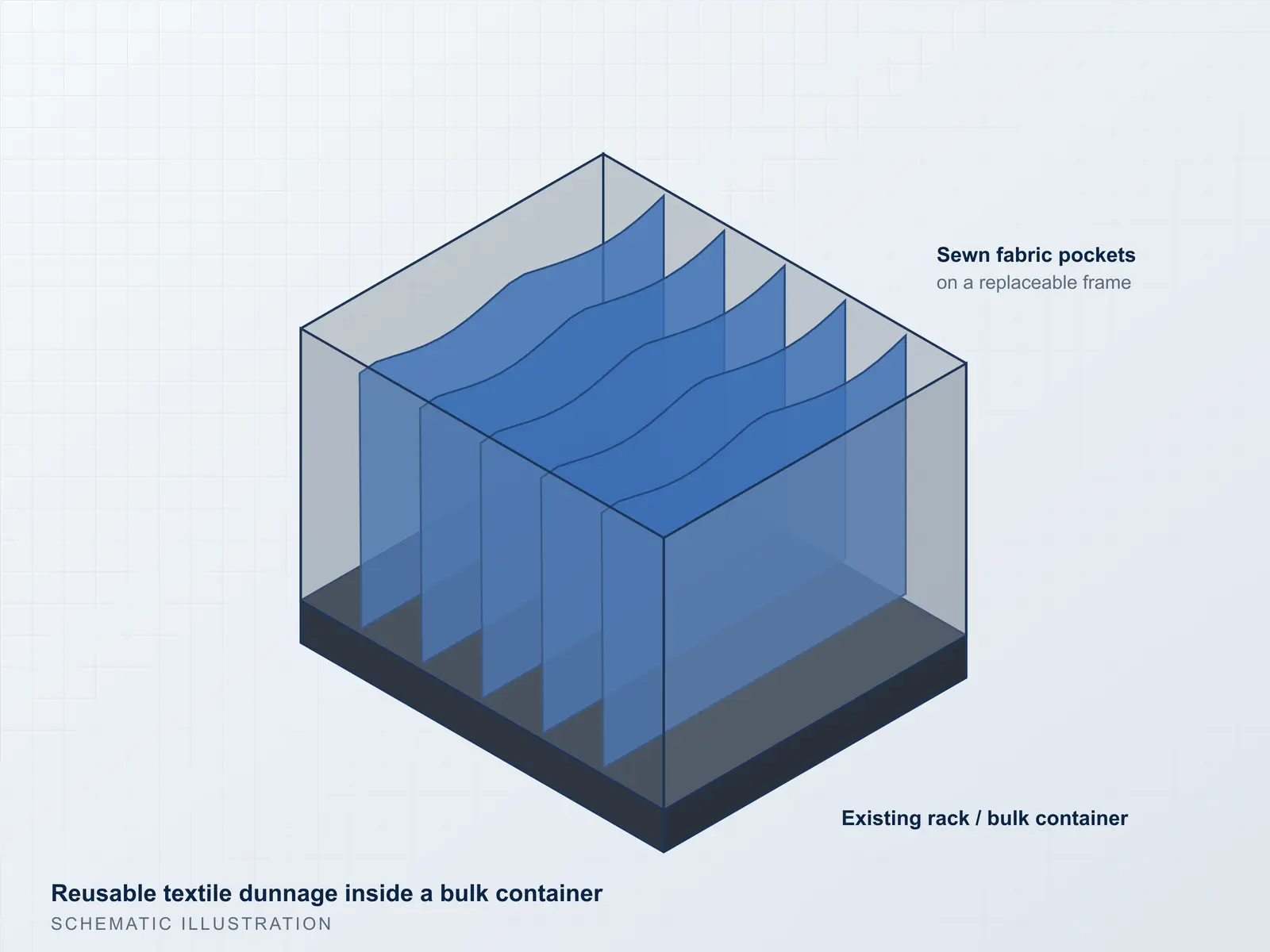
Custom Textile Dunnage & Fabric Dividers
Sewn fabric pockets, bags and dividers that fit inside your existing racks, bulk containers and totes — protecting Class-A painted and decorative parts through repeated trips, with replaceable inserts when they wear.
- Minimum order
- Sample set first; production per rack/container count after sample approval.
- Lead time
- Sample and production timing confirmed per project.
Textile dunnage is the interior of a returnable container: pockets, bags and dividers that hold each part apart so painted, chromed or decorative surfaces arrive without marks. Compared with rigid dunnage it is lighter and folds or nests, and it is widely used for automotive Class-A parts, electronics and other sensitive components.
The commercial logic is replacement: containers and steel racks last for years, but their inserts wear, get contaminated or must change when the part changes. Replacing only the textile interior — built to the same drawing — keeps the fleet running without buying new containers, and inserts ship compactly because the frame stays with the customer.
How we work: send the container’s inner dimensions (or the existing insert), part geometry and weight, number of parts per layer and the surface requirement. The manufacturer builds a sample for trial fitting; the approved sample becomes the reference for every repeat order.
Key specifications
| Insert types | Pockets/pouches, bags, divider curtains, sleeves on framesSource: orbiscorporation.com |
|---|---|
| Materials (typical) | Polyester and nylon fabrics, non-wovens (e.g. spunbond), coated fabrics; soft-touch liners for Class-A surfacesSource: logisticpackaging.com |
| Container types | Steel racks, bulk containers, hand-held totes, KLTSource: orbiscorporation.com |
| Construction | Sewn and/or welded; stiffening rods or frames; hook, loop or clip attachment |
| Surface protection | Material chosen for the finish; abrasion and lint behaviour validated on samplesSource: ssitote.com |
| End of life | Recyclable textile options available (manufacturer-dependent)Source: logisticpackaging.com |
Typical, configurable ranges compiled from published manufacturer data. Final values are confirmed per order in the quotation and supporting test documents.
Materials
Polyester/nylon fabrics, spunbond non-wovens, coated fabrics and soft-touch liners; frames in steel rod, aluminium or plastic depending on the rack.
Dimensions & formats
Built to the container’s inner dimensions and the part layout; pocket pitch and depth from the part drawing.
Options & customisation
- Colour coding and part-number labels
- Replaceable insert kits per rack type
- Reinforcement at contact points
Applications
- Painted bumpers, trims and panels (Class-A)
- Interior decorative parts
- Electronic assemblies
- Glass and mirror components
- Work-in-process racks
- Replacement of worn inserts in existing fleets
Ordering information
Minimum order
Sample set first; production per rack/container count after sample approval.
Lead time
Sample and production timing confirmed per project.
Packaging
Folded and compressed in cartons; frames shipped flat where applicable.
Loading & shipping
Very compact — inserts ship without the container, so freight per set is low.
Anti-static (ESD) or low-lint claims require testing of the exact material and are only stated with a test report. PPWR obligations depend on the packaging function and the operator — material data is supplied, compliance is not assumed.
Technical documentation
- Material data sheetsAvailable on request with your RFQ
- Approved sample record and drawingAvailable on request with your RFQ
- ESD / abrasion test reportOnly where tested for the exact material
Frequently asked questions
Can you copy our existing inserts?
Yes — send an insert or detailed drawings; the manufacturer measures it, builds a sample and we compare fit and protection before production.
Textile or plastic dunnage?
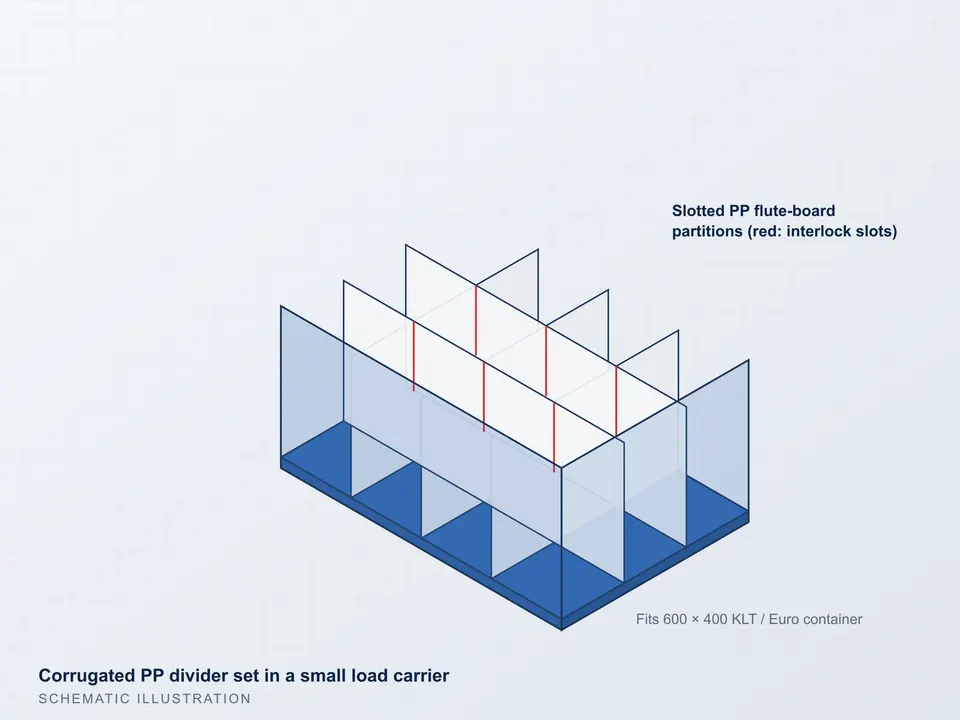
Textile is lighter, gentler on finished surfaces and compacts for return; rigid plastic or PP dividers suit heavier parts and simpler geometries.
How do repeat orders work?
Each approved design gets a reference number and sample; repeat orders only need the quantity and delivery date.
Research references
Related products
Request a Quotation: Custom Textile Dunnage & Fabric Dividers
Tell us what you need. A specialist reviews every request and replies with a quotation or clarifying questions — usually within one business day.