Water & Civil Infrastructure
How many soakaway or attenuation crates do I need?
A quick way to turn a required storage volume into a module count — with the assumptions that make the difference between a budget figure and a design.
Updated: 27 September 2026
Preliminary sizing: number of attenuation / soakaway modules
Preliminary estimate only. Hydraulic design (e.g. to BRE 365 or CIRIA C753), infiltration rate, cover depth and traffic loading must be confirmed by the drainage designer.
Request a quote for this quantityThe basic calculation
A geocellular tank stores water in the void inside the modules. The number of modules is therefore:
modules = required storage volume ÷ (module volume × void ratio)
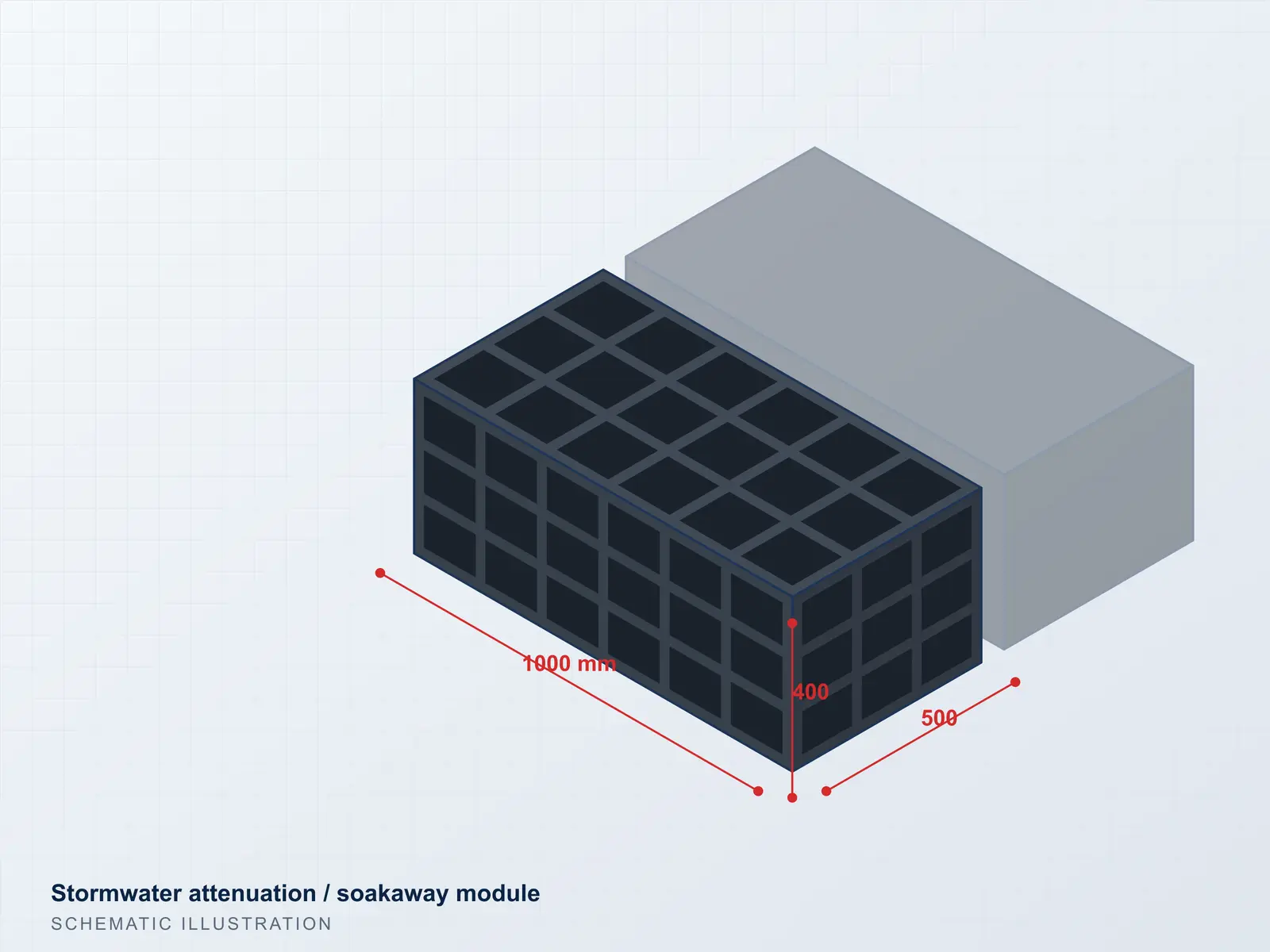
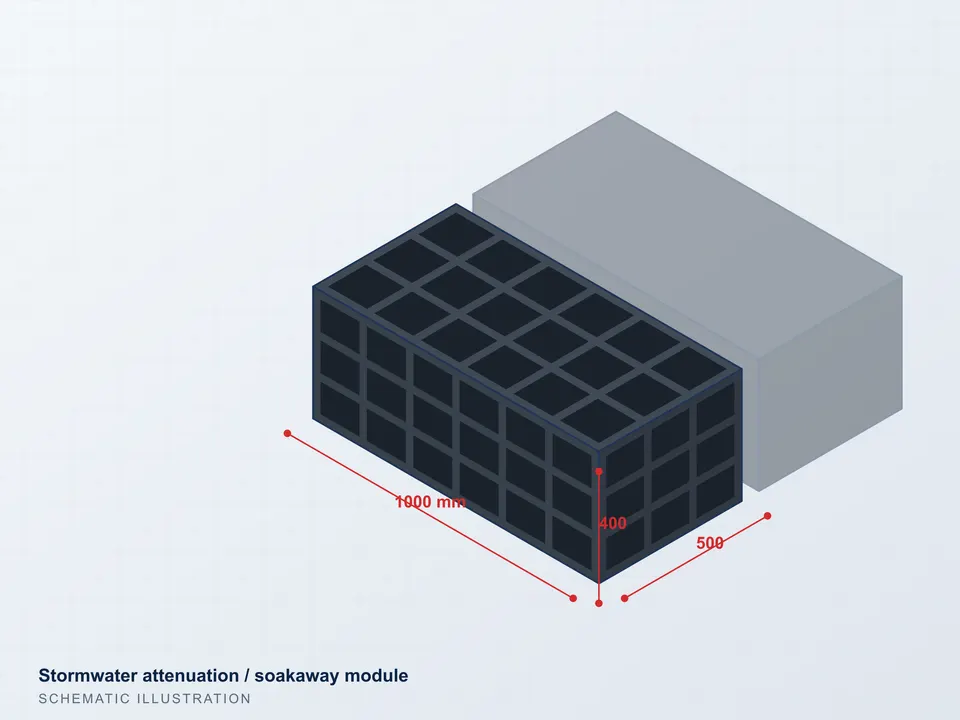
For a 1000 × 500 × 400 mm module, the gross volume is 0.2 m³. At a 95% void ratio, each module stores about 0.19 m³, so 10 m³ of storage needs about 53 modules. The calculator above does this for common module sizes and passes the result into a quotation request.
Where the required volume comes from
The storage volume is the output of the drainage design, not an input you choose. For attenuation it depends on the site area, the design storm, the allowable discharge rate and climate-change allowances; for soakaways it also depends on the measured infiltration rate of the soil. In the UK, soakaways are commonly sized using BRE Digest 365 infiltration testing, and SuDS design follows the national standards referenced in planning policy. If you only have an area and a rainfall depth, the "catchment" mode gives a rough first estimate — treat it as budgeting only.
Things that change the module count
- Void ratio — most modules are around 95%, but check the product data.
- Layers and footprint — the same volume can be a wide single layer or a deeper multi-layer tank; the load class and cover depth limit the number of layers.
- Inspection and access modules — these take up positions in the layout.
- Freeboard and silt allowance — designers often add margin for sediment.
Before you order
Confirm the load class for the traffic above the tank and the minimum/maximum cover depth, decide on geotextile or geomembrane wrap, and check whether your authority requires a specific product approval.
Frequently asked questions
Does the calculator replace a drainage design?
No. It converts a volume into a module count for budgeting. The storage volume, infiltration rate and load class must come from a qualified drainage designer.
What void ratio should I use?
Use the value from the data sheet of the module you will buy; 95% is typical for modern PP modules.
Related products
Request a Quotation
Tell us what you need. A specialist reviews every request and replies with a quotation or clarifying questions — usually within one business day.