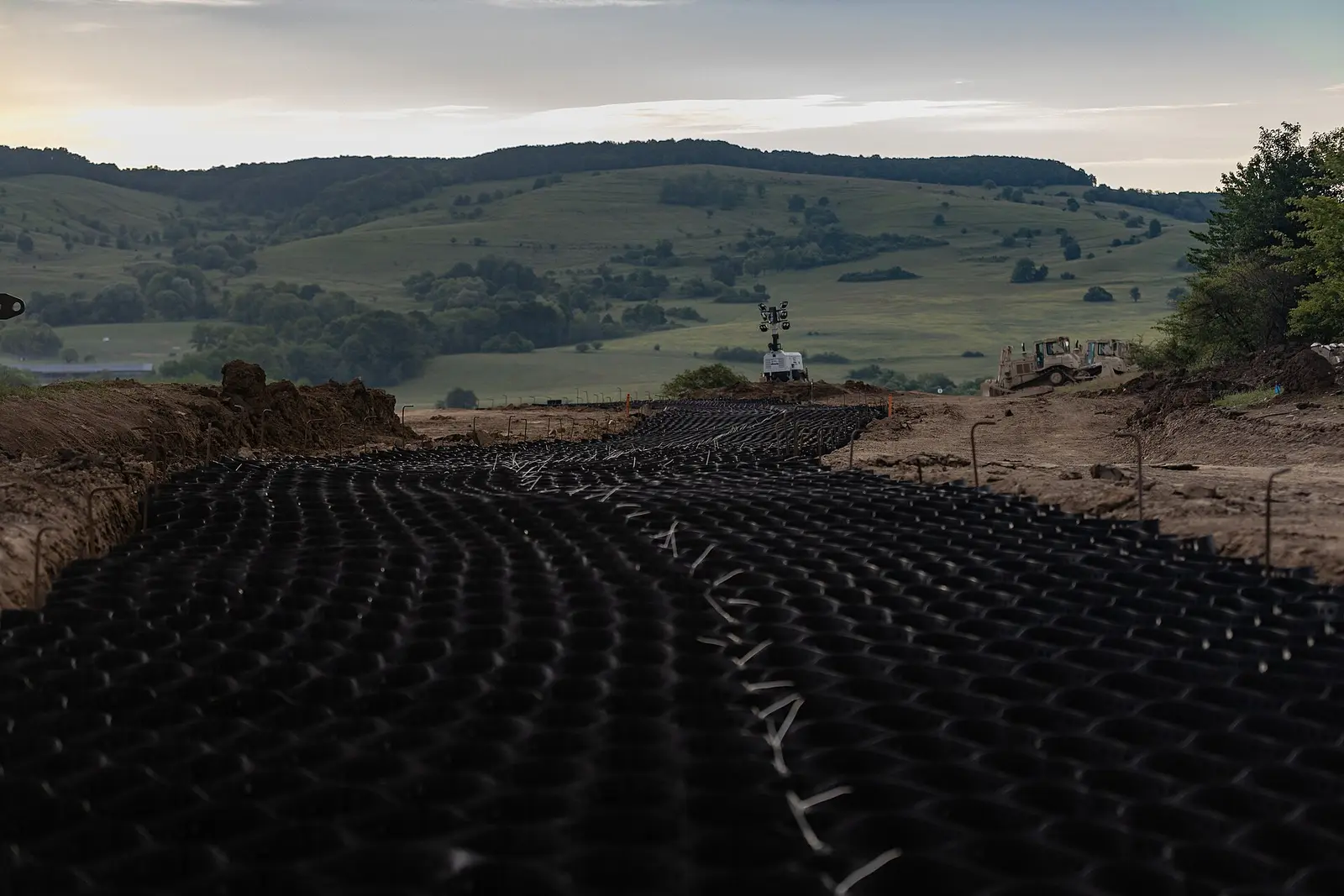
HDPE Geocells (Cellular Confinement)
Ultrasonically welded HDPE strips that expand into a honeycomb for slope protection, load support and erosion control. Cell depths 50–200 mm, weld spacing 330–445 mm.
- Minimum order
- Sampling from one panel set; project orders by the container.
- Lead time
- Confirmed per quotation.
Geocells confine infill — soil, sand, aggregate or concrete — inside a three-dimensional honeycomb. The confinement increases the stiffness of the layer, spreads load and holds material on slopes and channel banks.
Specification is mostly a combination of cell depth, weld spacing and strip thickness/surface. Deeper cells and closer welds give more confinement for weak subgrades and heavier traffic; perforated, textured strips improve drainage and friction with the infill.
The geosynthetics cluster around Tai’an in Shandong produces geocells at very large scale, which is why we treat this as a consolidation product: we qualify two to three factories, verify strip thickness and weld strength on samples, and ship collapsed panels with geotextile or anchors in the same container.
Key specifications
| Cell depth | 50, 75, 100, 150, 200 mmSource: basekim.com |
|---|---|
| Weld spacing | 330, 356, 445 mm (others on request)Source: glgeosynthetics.com |
| Strip thickness | ≈ 1.0–1.7 mm; e.g. 1.1 mm smooth, 1.5 mm perforatedSource: glgeosynthetics.com |
| Strip surface | Smooth or textured; perforated or non-perforatedSource: basekim.com |
| Material | HDPESource: glgeosynthetics.com |
| Joining | Ultrasonic welding of stripsSource: glgeosynthetics.com |
Typical, configurable ranges compiled from published manufacturer data. Final values are confirmed per order in the quotation and supporting test documents.
Materials
High-density polyethylene strips, ultrasonically welded; UV-stabilised on request for exposed applications.
Dimensions & formats
Panels are supplied collapsed and expand on site; expanded panel size depends on depth, weld spacing and number of strips.
Options & customisation
- Colour (black standard; green or tan for visible slopes)
- Anchors, tendons and geotextile supplied together
Applications
- Slope and embankment protection
- Load-support layers for access roads and yards
- Channel and riverbank lining
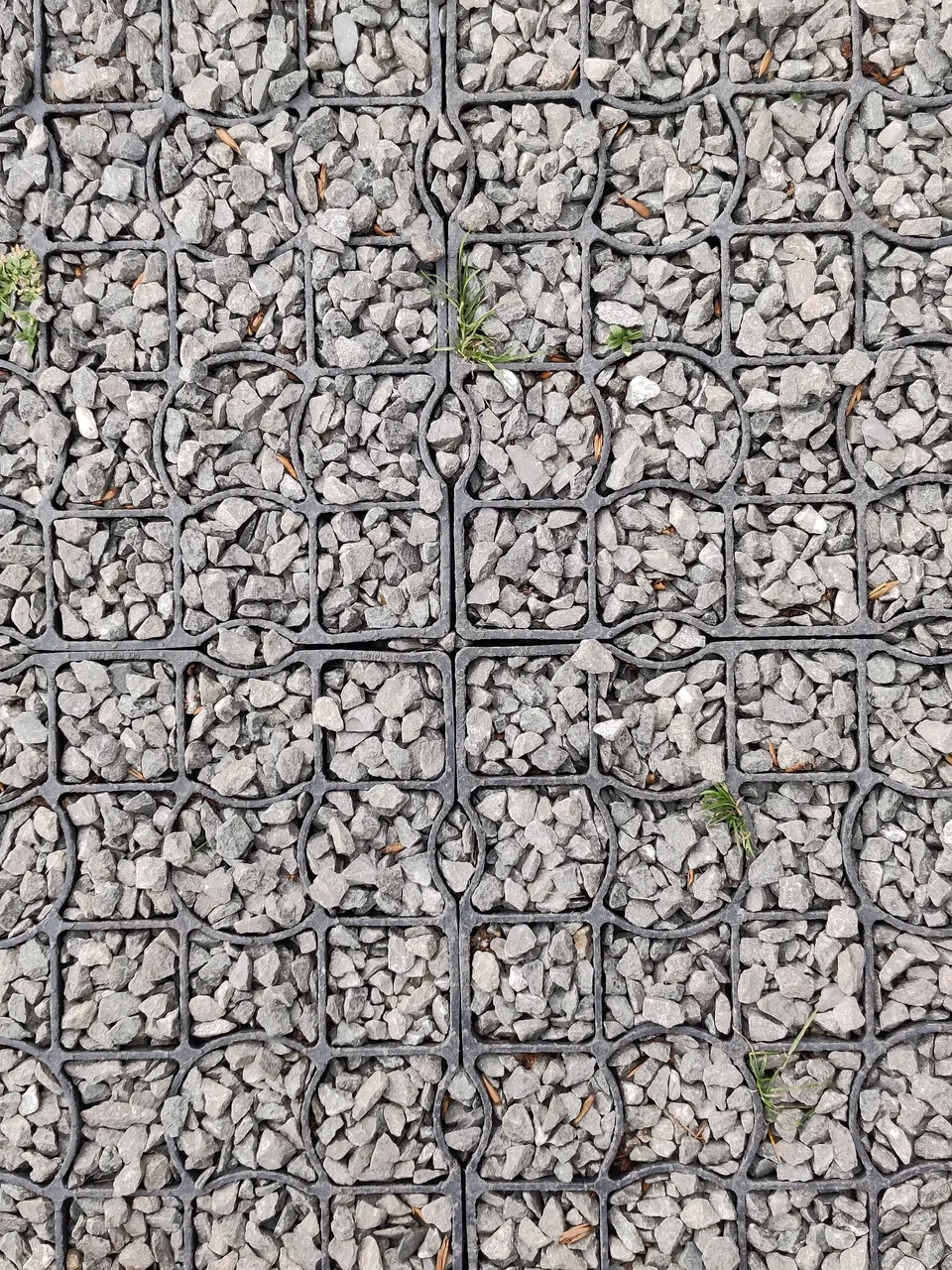
- Gravel driveway stabilisation
- Retaining structures (to engineer’s design)
- Tree-root and landscape stabilisation
Ordering information
Minimum order
Sampling from one panel set; project orders by the container.
Lead time
Confirmed per quotation.
Packaging
Collapsed panels, strapped bundles on pallets or loose-loaded.
Loading & shipping
Very dense when collapsed — often combined with geotextile or gravel grids in one shipment.
Technical documentation
- Technical data sheetAvailable on request with your RFQ
- Weld peel strength and sheet thickness test reportPer batch where available
- Installation guideAvailable on request with your RFQ
Frequently asked questions
Which cell depth do I need?
It depends on subgrade strength, traffic and slope. Designers commonly use 100–150 mm cells with closer weld spacing for heavy traffic on weak ground; your engineer should confirm.
Perforated or non-perforated?
Perforated strips improve drainage and interlock with granular infill; non-perforated strips are used where infill must be retained, for example in some channel linings.
Do you supply anchors and geotextile?
Yes, they can be consolidated in the same shipment.
Research references
Related products
Request a Quotation: HDPE Geocells (Cellular Confinement)
Tell us what you need. A specialist reviews every request and replies with a quotation or clarifying questions — usually within one business day.